QCU

QCU

QCU

Enables precise qubit measurement and control with a signal bandwidth from DC to 20 GHz.

Enables precise qubit measurement and control with a signal bandwidth from DC to 20 GHz.

 SDT의 QCU는 정밀한 큐비트 제어와 신뢰성 높은 측정을 통해 안정적인 양자컴퓨팅을 구현하는 핵심 솔루션입니다.
 SDT의 QCU는 정밀한 큐비트 제어와 신뢰성 높은 측정을 통해 안정적인 양자컴퓨팅을 구현하는 핵심 솔루션입니다.

Overview

SDT’s QCU is a core solution for stable quantum computing, delivering precise qubit control and reliable measurement. The Basic model supports frequencies up to 8.5 GHz with 6 RF channels per unit, while the High Density (HD) model supports frequencies up to 20 GHz with 16 RF channels per unit. Both models enable flexible control and measurement of multiple qubits, effectively supporting complex quantum algorithms and error correction protocols.

Basic

• Precise qubit control and measurement with a signal bandwidth of up to 8.5 GHz
• Supports up to 6 output channels and 2 input channels
• Easy channel expansion with modular 3-channel RF cards
• Supports up to 6 direct digital synthesis (DDS) DAC channels per unit
• Compatible with superconducting, neutral-atom, and diamond NV-center qubits
• Supports pulse design and pulse sequencing using a high-speed AWG for gate operations

High Density (HD)

• Precise qubit control and measurement with a signal bandwidth of up to 20 GHz
• Supports up to 16 output channels and 8 input channels
• Easy channel expansion with modular 4-channel RF cards
• Multi-tone output (up to 7 tones, 2 channels)
• Supports up to 16 direct digital synthesis (DDS) DAC channels per unit
• Compatible with superconducting, neutral-atom, diamond NV-center, trapped-ion, and silicon spin qubits
• Supports pulse design and pulse sequencing using a high-speed AWG for gate operations
• Ensures phase continuity between pulses within each channel
• Real-time branching based on mid-circuit measurement
• Hardware synchronization between QCU units
• Pulse event marker outputs planned for future support
• Supports a web UI, Python SDK, and SDT’s optional QubeCore qubit control software

EXTENSION BOARDS

Expansion boards tailored to your requirements

Select and configure the cards suitable for your operating environment in units of 3 channels (Basic) or 4 channels (HD).

Extension Board

Print Range

Basic

HD

Examples of Use

LF

Low Frequency

DC - 500 MHz

Neutral-Atom and Trapped-Ion Qubit Cooling
Neutral-Atom Qubit Rearrangement and Gate Operations

HF

High Frequency

10 MHz - 8.5 GHz

Superconducting Qubit Control and Measurement
Silicon Spin Qubit Control and Measurement

MW

Microwave

20 GHz

-

Silicon Spin Qubit Control and Measurement
Trapped-Ion Qubit Cooling and Control

DC

Direct Current

± 12 V

-

Superconducting Qubit Control and Frequency Tuning
Silicon Spin Qubit Quantum Dot Control and Measurement

Application

SDT QCU(Qubit Controller Unit)

Cryogenic Microwave-Based Quantum Computing

Supports the generation and measurement of multi-GHz I/Q signals required for superconducting and spin quantum computing.
SDT QCU(Qubit Controller Unit)

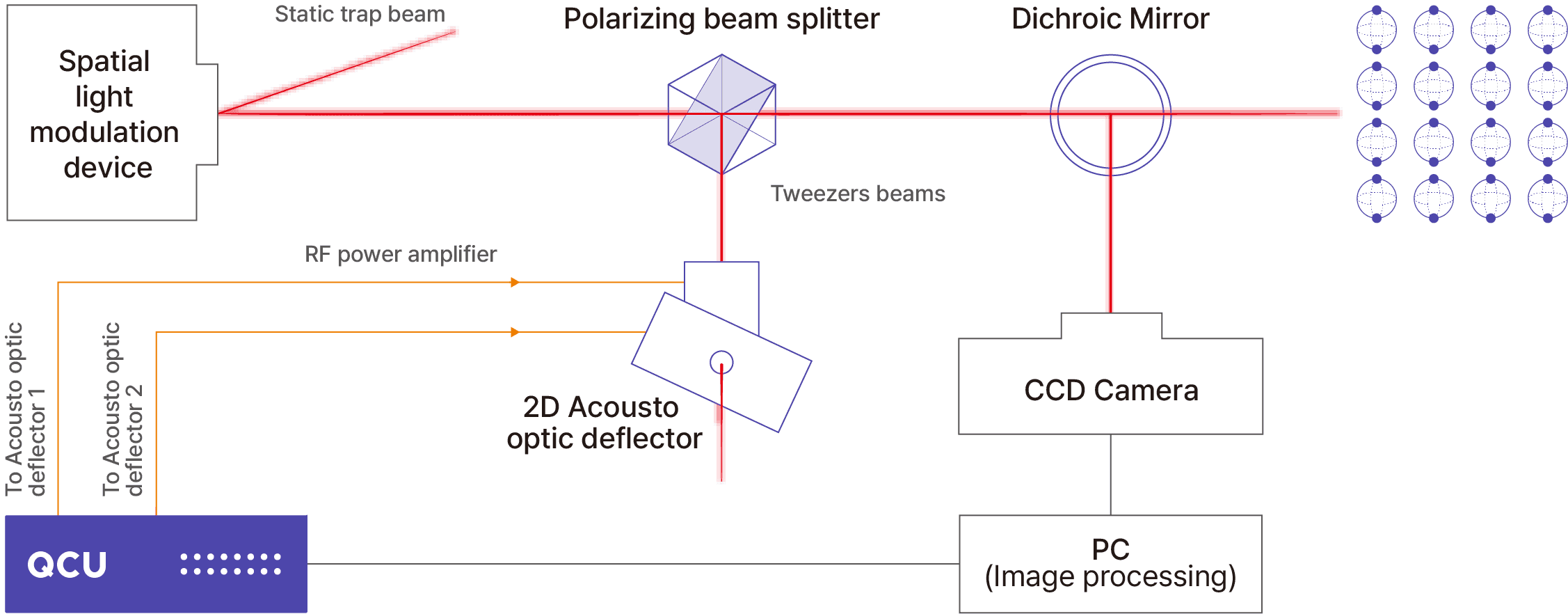
Atomic and Ion-Based Quantum Computing

It can be used as a high-performance AOM/AOD driver required for implementing neutral-atom and trapped-ion quantum computers.

Functional Description

SDT QCU(Qubit Controller Unit)

USE CASE

SUPERCONDUCTING QUBITS

QubeCore, a qubit control software developed by SDT, handles quantum experiment equipment control and experiment automation, quantum algorithm development and hardware execution, new QPU platform integration and calibration, and hardware infrastructure and quantum material correlation. The results below were derived by controlling the QCU using the QubeCore Python API.

Readout Resonator Spectroscopy

Experiment Objective: Optimize the readout signal frequency
Measurement/Calibration Target: Readout pulse frequency calibration

Experiment Objective: Optimize the readout signal frequency
Measurement/Calibration Target: Readout pulse frequency calibration

Through QCU's precise hardware signal control technology, various frequencies are applied to capture subtle changes in the spectroscopic signals essential for qubit measurement. Based on this, the optimal measurement frequency is determined to automatically update the readout frequency of the corresponding qubit.

Qubit Spectroscopy

Experiment Objective: Identify the qubit operating frequency
Measurement/Calibration Target: Qubit drive pulse frequency calibration

Experiment Objective: Identify the qubit operating frequency
Measurement/Calibration Target: Qubit drive pulse frequency calibration

To find the qubit frequency essential for qubit gate operations, pulses are applied through the drive line while varying the frequency, and signal changes on the readout line are measured. Based on this data, the optimal qubit frequency is automatically updated.

Amplitude Rabi

Experiment Objective: Determine the pulse amplitude for single-qubit gates
Measurement/Calibration Target: Qubit drive pulse amplitude calibration

Experiment Objective: Determine the pulse amplitude for single-qubit gates
Measurement/Calibration Target: Qubit drive pulse amplitude calibration

To implement single-qubit gate operations, Rabi oscillation data is measured by gradually increasing the amplitude while keeping the pulse length fixed. The measured data is then analyzed to automatically derive the gate amplitude value.

Ramsey Experiment

Experiment Objective: Correct qubit drive frequency errors and measure qubit coherence time
Measurement/Calibration Target: Fine calibration of the qubit drive frequency and T₂* measurement

Experiment Objective: Correct qubit drive frequency errors and measure qubit coherence time
Measurement/Calibration Target: Fine calibration of the qubit drive frequency and T₂* measurement

The qubit's coherence time is evaluated by measuring the damped oscillation signal while incrementally increasing the idle time between the two gates. Based on this data, fine errors in the qubit frequency are precisely calibrated.

SPECIFICATIONS

Detailed Specifications

BasicHigh Density (HD)
Core EngineXCZU49DR-FFVF1760
I/O Channels3+3 / 24+4+4+4 / 4+4
Frequency RangeExtension Board Combinations
LF, HFLF, HF, MW, DC
RF Output6 (3+3)16 (4+4+4+4)
Frequency RangeLF (500 MHz), HF (8.5 GHz)LF (500 MHz), HF (8.5 GHz), MW (20 GHz), DC
Power Range-40 dBm to +4.5 dBm
D/A Conversion14-bit, 9.85 GSa/s
Phase Noise-105 dBc/Hz @ 100 Hz-113 dBc/Hz @ 1kHz-115 dBc/Hz @ 10kHz
Signal to Noise Ratio> 80 dBc @ 30 dBm
Impedance50 Ω
RF Input28 (4+4)
Frequency Range8.5 GHz
Power Range-40 dBm to +4.5 dBm
A/D Conversion14-bit, 2.5GSa/s
Impedance50 Ω
AWGTiming Resolution2.0 ns
User-defined pulse shape synthesisSupported
Pre-defined pulse shapesSquare, Gaussian, DRAG, Triangle, Ramp Up, Ramp Down
SoftwareUIWeb-UI
SDKPython, C++ SDK
QubeCoreQubeCore (full-stack qubit control software developed by SDT), optional
GeneralConnectorsSMA female
CommunicationLAN/Gigabit Ethernet
Power supplyAC 100–240 V, 50–60 Hz

KC Certification (Certificate)

R-R-2Dt-SDT-Q-QCU-100

KC Certification (Test Report)

DST-25E-2395

TTA Test Report

TTA-26-02590

Do you need our support?

Focus on your science. We’ll handle the hardware.

Do you need our support?

Focus on your science. We’ll handle the hardware.

Do you need our support?

Focus on your science. We’ll handle the hardware.

English

SDT Inc.

10F, 5, Teheran-ro 44-gil, Gangnam-gu, Seoul, Republic of Korea 06211

Business registration number: 630-87-00933

Copyright© SDT Inc., All rights reserved.

Logo
Logo
Logo
Logo
English

SDT Inc.

10F, 5, Teheran-ro 44-gil, Gangnam-gu, Seoul, Republic of Korea 06211

Business registration number: 630-87-00933

Copyright© SDT Inc., All rights reserved.

Logo
Logo
Logo
Logo
English

SDT Inc.

10F, 5, Teheran-ro 44-gil, Gangnam-gu, Seoul, Republic of Korea 06211

Business registration number: 630-87-00933

Copyright© SDT Inc., All rights reserved.

Logo
Logo
Logo
Logo