



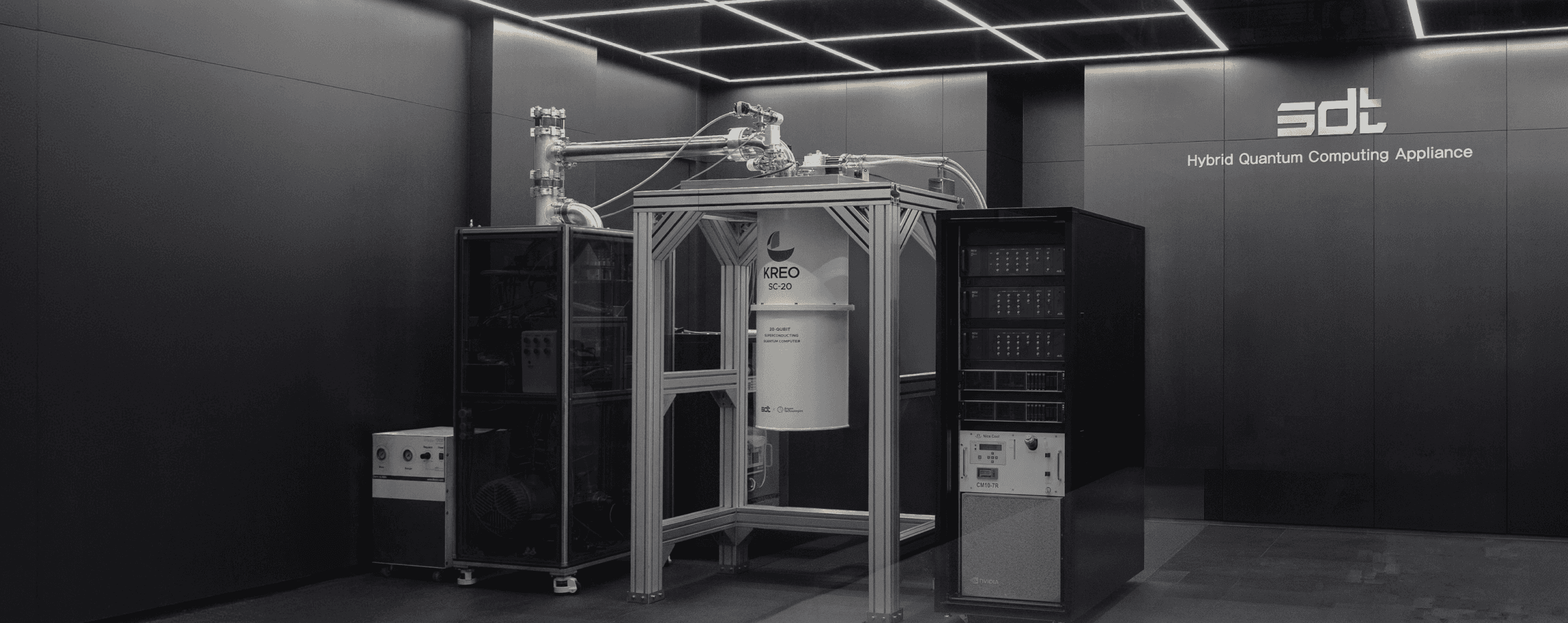
KREO NA is a quantum computer system based on neutral atom and ion trap qubits, offering long coherence times and high qubit connectivity. It is designed to link organically with classical computing resources like GPUs within a single architecture.
The system operates on QubeCore, a quantum OS developed in-house by SDT, and precisely controls qubits with laser pulses via the Kasli FPGA controller based on the open-source ARTIQ framework. This provides an integrated solution optimized for academic and research neutral atom and ion trap system environments, allowing both modalities to be utilized together on the same operating system as KREO SC.
Currently, KREO offers various product lines based on qubit modalities. Integrate and operate different quantum hardware with a single software stack.
Composed of a superconducting qubit-based QPU and a Xilinx Zynq UltraScale+ RFSoC(ZCU216) quantum system controller. Precisely controls qubits via microwave pulses through QuBIC firmware.
Qubit
Superconducting
QCS
ZCU216 (RFSoC)
Firmware
QubiC
Control
Microwave Pulse
From operators and researchers to external service providers, KREO delivers software tools tailored to each user's role.
All core logic for quantum computer operations is integrated into QubeCore, the quantum OS.
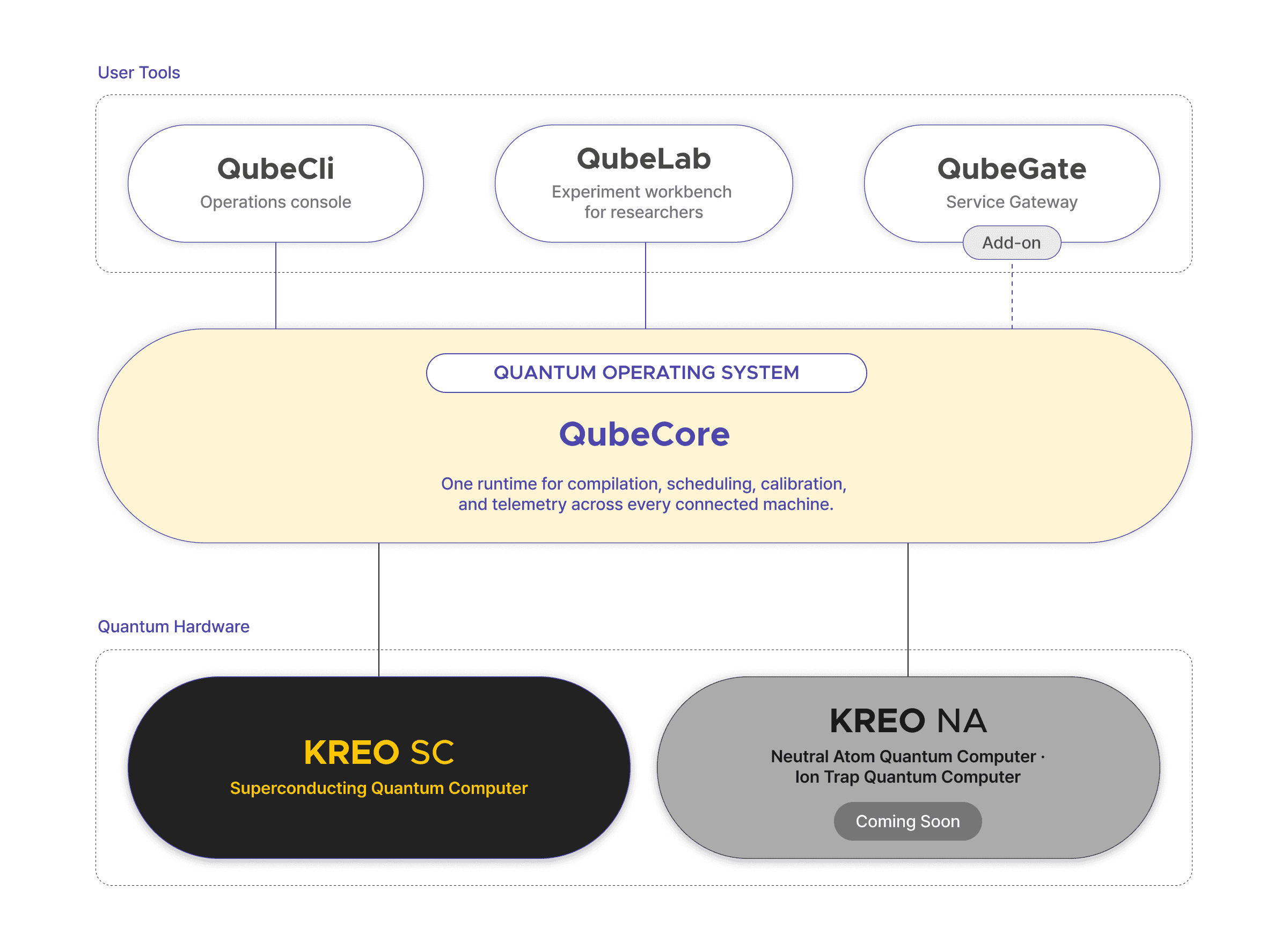
The brain of KREO and its quantum operating system. It provides all core logic for quantum computer operations — from circuit compilation and job scheduling to calibration automation and telemetry collection. Through a HAL (Hardware Abstraction Layer) plugin architecture, it simultaneously supports superconducting (QuBIC) and neutral atom (ARTIQ) systems, and future quantum platforms can be integrated simply by adding a new plugin.
From dedicated in-house research to external service provision and FTQC-ready upgrades — KREO is designed to scale incrementally in line with the growth of your research and services.

The foundational configuration for institutions — such as universities and national research labs — that operate quantum computers for their own research purposes. Operators manage the system via QubeCli, while researchers conduct pulse-level experiments using QubeLab.
Configuration
QubeCore
QubeCli
QubeLab